Showing posts with label military-industrial complex. Show all posts

Monday, August 12, 2024

The 2024 United States National Defense Strategy - The High Cost of Rebuilding the American Military Machine

The Commission on the National Defense Strategy for the United States recently released its final report to Congress and the President of the United States (whoever they may be) and some of the conclusions are eye-opening.


Here is the cover page of the 2024 edition of the National Defense Strategy report:


The authors of the report found that, among the senior civilian and military leaders of the Department of Defense and other departments; congressional leaders from relevant committees; private sector representatives; former government officials; experts in the think tank, academic, and federally funded research and development centre communities; and foreign allies that they met with, there was "near-unanimous recognition of the significant challenges to U.S. national security and broad agreement on the need for substantial and wide-ranging change" and that the national security system was outdated, bureaucratic and too political to make the changes that are necessary to protect America's role as global "police force" quickly enough.  There is also a reliance on decades-old military equipment and a culture of risk avoidance that is handicapping the U.S. military's ability to maintain its current role in the current unipolar world that is under threat from two growing superpowers.


The report opens by observing that both China and Russia are the major powers that seek to undermine U.S. global interest and that, in many ways, China is outpacing the United States and has negated America's military advantage in the Western Pacific over the past two decades.  In both cases, the report states that military spending by the superpowers-in-waiting is rising;  in 2024, Russia is estimated to spend 35 percent of its federal budget or 7.1 percent of its GDP on national defense and China announced a 7.2 percent increase in its official defense spending bringing it to 1.6 percent of GDP (excluding very significant off-budget items).  This compares to roughly 3 percent or 12 percent of government spending for the United States.  As well, China and Russia's "no limits" partnership formed in February 2022 along with the joint military and economic partnership with Iran and North Korea presents a growing threat to U.S. interests.


The report goes on to note that all-out war with a peer or near peer would be devastating for several reasons:


1.) massive military and personnel costs which is problematic given that recent recruitment shortfalls have resulted in decreased size of the Army, Air Force and Navy. 


2.) risk of cyberattacks on America's critical infrastructure.


3.) global economic recession due to disruptions to supply chains, manufacturing and trade.


4.) denied access to critical minerals needed to run the American economy and build weapons systems.


5.) hold U.S. space assets at risk.


Here is a quote with my bolds:


"The U.S. public are largely unaware of the dangers the United States faces or the costs (financial and otherwise) required to adequately prepare. They do not appreciate the strength of China and its partnerships or the ramifications to daily life if a conflict were to erupt. They are not anticipating disruptions to their power, water, or access to all the goods on which they rely. They have not internalized the costs of the United States losing its position as a world superpower. A bipartisan “call to arms” is urgently needed so that the United States can make the major changes and significant investments now rather than wait for the next Pearl Harbor or 9/11. The support and resolve of the American public are indispensable."


The authors of the report recommend that the U.S. Joint Force be structured to simultaneously:


1.) defend the homeland, maintain strategic deterrence, prevent mass casualty terrorist attacks, maintain global posture, and respond to small-scale, short-duration crises.


2.) lead the effort, with meaningful allied contribution, to deter China from territorial aggression in the Western Pacific—and fight and win if needed


3.) lead NATO planning and force structure to deter and, if necessary, defeat Russian aggression


4.) sustain capabilities, along with U.S. partners in the Middle East, to defend against Iranian malign activities.


As I noted above, the authors have taken notice of the decreased ability of the U.S. military to recruit new personnel which you can clearly see on this graphic from RealClear Defense:


Here is another quote from the Commission's report that is rather sobering for young Americans (with my bold):


"Redoubled recruiting efforts, new incentives for service, and more flexible personnel systems are needed to offset a lack of propensity for and interest in military service among the eligible population. Military retention remains high, demonstrating that personnel in service largely choose to remain in uniform. The nation must also consider the possibility that future conflict could overwhelm the capacity of the active-duty force and should plan now to better prepare the reserve components and, potentially, a broader mobilization.  More broadly, we support calls for increased levels of public and civil service to help provide a renewed sense of engagement and patriotism among the American people."


Get ready for a full-fledged, Vietnam War-style draft which, as one might expect, will not impact the offspring of the ruling class.


Of course, the recommended solution to the problem is a greater level of funding.  According to the report, Department of Defense spending ranged from 4.9 percent to 16.9 percent of GDP during the Cold War as shown here:


Keep the 4.9 percent to 16.9 percent of GDP numbers in mind.  During the Cold War, it is important to remember that DoD spending relied on top personal marginal income tax rates of 70 percent and corporate tax rates averaging 50 percent.  As such, the Commission makes the following recommendations:


1.) DoD should immediately review all major systems against likely future needs, emphasizing battlefield utility and prioritizing agility, interoperability, and survivability.  DoD should invest more in cyber, space, and software, which have enabled warfighting for decades but are now central to conflict and have global reach.


2.) Congress should pass a supplemental appropriation immediately to begin a multiyear investment in the national security innovation and industrial base. Funding should support U.S. allies at war; expand industrial capacity, including infrastructure for shipbuilding and the ability to surge munitions production; increase and accelerate military construction to expand and harden facilities in Asia; secure access to critical minerals; and invest in a digital and industrial workforce.


3.) DoD should immediately begin making structural changes and prioritization adjustments to spend national security funds more effectively and more efficiently. DoD should address its recruitment challenges, rewrite regulations to speed defense procurement (and address cultural impediments and risk aversion), and shift the R&D paradigm to adopt technological innovation from outside the department for warfighting purposes. The U.S. government should review national security authorities for agencies other than DoD and look for ways to enable and facilitate information-sharing, coproduction, and export controls to better work with allies.


4.) Congress should revoke or override the caps in the 2023 Fiscal Responsibility Act that serve as the basis for the FY 2025 budget request.


a.) For FY 2025, real growth in defense and nondefense national security spending is needed and, at a bare minimum, should fall within the range recommended by the 2018 NDS Commission.  Increased spending should be allocated to emphasize near-term readiness demands to restore and reinforce deterrence.  


Here is a graphic showing the budgetary shortfall when compared to the 2018 NDS Commission:


b.) Given the severity of the threats, the FY 2027 and later budgets for all elements of national power will require spending that puts defense and other components of national security on a glide path to support efforts commensurate with the U.S. national effort seen during the Cold War.


c.) Larger amounts of defense spending should be accompanied by sufficient resources to build capacity at the departments of State, Commerce, and Treasury; intelligence, trade, and investment agencies; the U.S. Agency for International Development; and the Department of Homeland Security and focus these organizations on national security missions. The United States should continue to provide support to its allies, which it relies on to fight with (or for) it.


d.) The ballooning U.S. deficit (and I might add debt) also poses national security risks. 


And, here's the key to the last recommendation:  


"Therefore, increased security spending should be accompanied by additional taxes and reforms to entitlement spending."


In other words, U.S. taxpayers should get used to the idea of increased taxes and decreases in entitlement spending for things like Medicare/Medicaid and Social Security at the same time as the nation's military industrial intelligence complex sticks its snout in the seemingly endless trough of taxpayer dollars.


If we look at the budgets for America's military during the Cold War which ranged from 4.9 percent to 16.9 percent of GDP and use the same percentages with the current GDP of $28.63 trillion (current dollars), the Pentagon's budget would range from $1.403 trillion to $4.838 trillion.  This compares to Fiscal Year 2024 spending of $948.6 billion on defense, $1.2 trillion on Social Security and $1.2 trillion on Medicare.


In closing, you can bet that this list of individuals that testified at the National Defense Strategy Meetings certainly had an impact on the Commission's recommendations for a larger U.S. military:


When you ask the military and its insiders what they want, it's highly unlikely that they are going to say "a smaller military" or "peace", isn't it?  Another Cold War is a wet dream for these men and women not to mention the upper floor, corner office dwellers at the nation's defense contractors.


Thursday, November 9, 2023

The United States - A Nation Built on a Foundation of Conflict

While Washington loves to point the finger at Russia for its current military operations in Ukraine, the United States itself is on the sending end of munitions to a wide variety of nations around the world.  Let's look at America's military activities around the world since its inception followed by a list of American-led wars since World War II followed by atally of bombs that it has dropped since military activities began in Afghanistan in 2001 at the beginning of the endless and unresolved War on Terror.


Here is a complete list of United States military and clandestine operations in foreign countries from 1798 to 2004 as compiled by Global Policy:


In an April 2021 paper entitled "Severe Humanitarian Disasters Caused by US Aggressive Wars against Foreign Countries", the China Society for Human Rights provides a list of wars that have been waged by the United States after World War II.  Here is a list of all wars and interventions in foreign nations (often touted as being humanitarian interventions or operations necessary to protect local civilians from brutal regimes) waged by the United States since the end of World War II:


Here is a complete list of the major wars and the cost in human terms:


Now, let's look at some detailed information from the conflicts since 2007 in the early stages of the War on Terror.  Thanks to the U.S. Air Force's Central more-or-less monthly Airpower Summary data releases, the latest of which looks like this:


...we have a complete count of how many bombs the United States military and its allies have dropped as shown on this table from Progressive with other nations including Lebanon, Libya, Pakistan, Palestine and Somalia:


Over the period between 2001 and 2021, a total of 377,055 bombs and missiles have been dropped for an average of 46 strikes per day.  Note that this count does not include drones which have killed thousands of civilians under strikes authorized by George W. Bush, Barack Obama, Donald Trump and Joe Biden.


The United States has increasingly become a warrior nation since the end of World War II as Washington fought what it determined was an existential conventional war against the spread of Soviet-style communism followed by a war against a foe, a decentralized and diverse group of what the American ruling class determined were terrorists, that didn't play the war game using traditional rules of combat.  With the current threat of a multipolar world and the unceasing efforts to convince us all that everything that Russia or China does is a threat to "our way of life" and the influence of the American military-intelligence-industrial complex on the government, it looks like the United States will continue to build on its foundation of conflict for the foreseeable future.


Monday, December 12, 2022

America's Military Aid to Ukraine - Will It Lead to Unintended Consequences?

Since the military actions began in Ukraine in February 2022, the Biden Administration has made it very clear that it is using Ukraine as a proxy in the existential battle against Vladimir Putin's Russia.  The Administration has made repeated announcements about supplying arms to Ukraine, however, unless American taxpayers are paying attention, they have no real idea about the actual volume of arms.  Fortunately, the United States Department of Defense and the Congressional Research Service have kept track of America's security/military assistance to Ukraine.


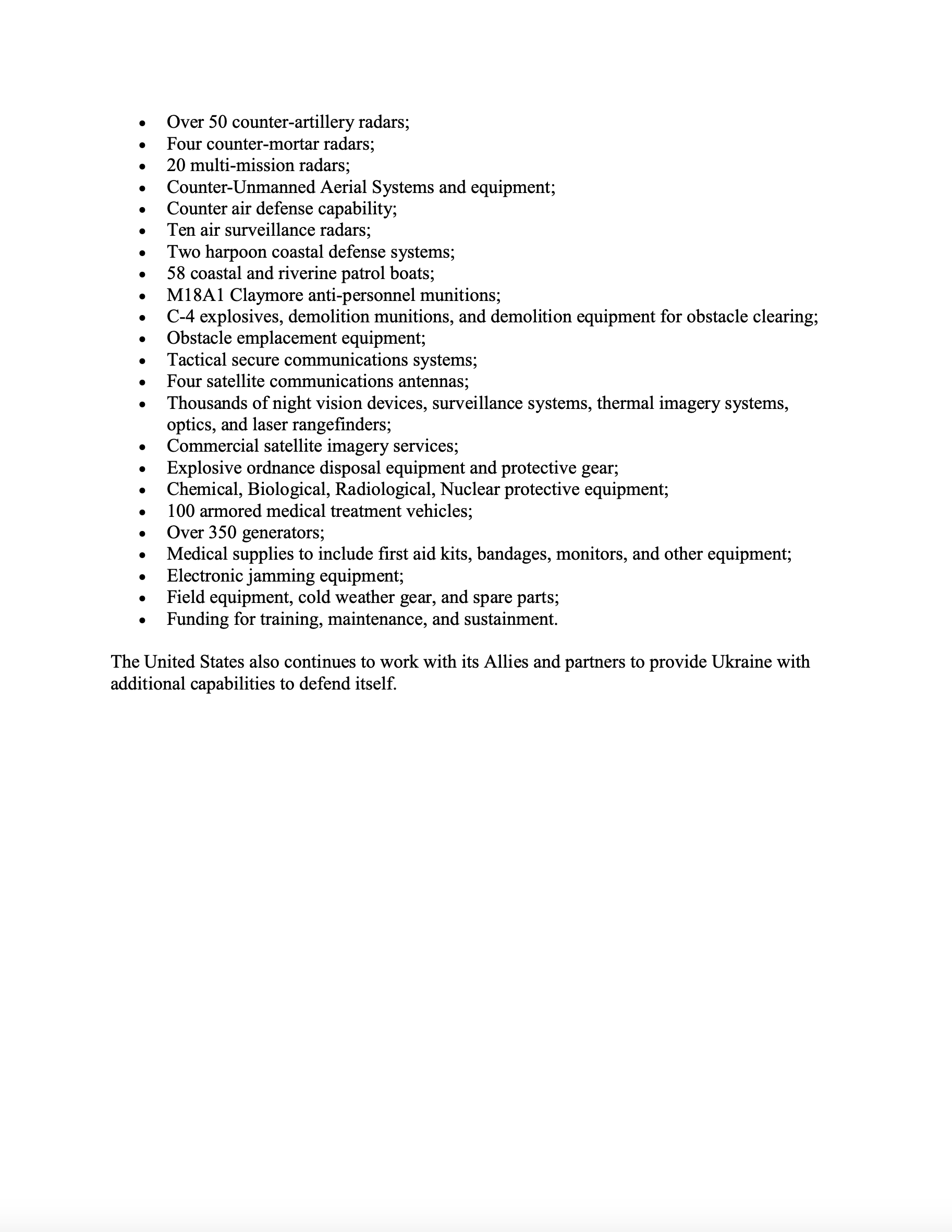
Let's start with this Fact Sheet from the U.S. Department of Defense releases which inventories the materiel that has been committed to the fight against Russia remembering that this does not include the materiel which has been sent by NATO partner nations:


In its U.S. Security Assistance to Ukraine report which was updated on December 7, 2022, the Congressional Research Service notes that fiscal year 2022 and 2023 security assistance packages are mainly funded using $28 billion in supplemental appropriations which, thus far, can be broken down as follows:


1.) $14.05 billion to replenish DoD equipment stocks that have been sent to Ukraine by way of presidential drawdown authority


2.) $9.3 billion for DoD's Ukraine Security Assistance Initiative (USAI)


3.) $4.65 billion in Foreign Military Financing for Ukraine and nations impacted by the situation in Ukraine.


Here is a table showing the presidential drawdowns (which allow the president to authorize the immediate transfer of articles and services from U.S. stocks) for Ukraine going back to fiscal 2021 prior to the Russian military actions:


If we go back even further, after the 2014 Maidan uprising and prior to February 24, 2022, the Obama, Trump and Biden Administrations provided Ukraine with:


"...nonlethal security assistance, such as body armor, helmets, vehicles, night and thermal vision devices, heavy engineering equipment, advanced radios, patrol boats, rations, tents, counter-mortar radars, uniforms, medical kits, and other related items. In 2017, the Trump Administration announced U.S. readiness to provide lethal weapons to Ukraine.


According to DOD, USAI packages prior to FY2022 provided sniper rifles, rocket-propelled grenade launchers, counter-artillery radars, Mark VI patrol boats, electronic warfare detection and secure communications, satellite imagery and analysis capability, counter-unmanned aerial systems (UAS), air surveillance systems, night vision devices, and equipment to support military medical treatment and combat evacuation procedures."


Here is a table showing selected U.S. Security Assistance to Ukraine for the period between fiscal 2016 and fiscal 2023:


According to the CRS report, Ukrainian officials have sought to acquire other advanced systems, including fighter aircraft, anti-ship, and additional air defense and anti-missile capabilities, however, the Biden Administration is concerned that this could lead to escalation.  For example, back in June 2022, Washington announced that it would send four of its HIMARS (High Mobility Artillery Rocket System) medium-range rocket system but with a reduced range that will make it difficult for Ukraine to attack Russian territory.  Additional HIMARS were announced as part of a $625 million package in October 2022 as shown here:


And, on the upside for the military-industrial complex, Lockheed Martin, manufacturer of HIMARS, will increase its production of the units from 60 launchers per year to 96 launchers per year to replace those that have been sent to Ukraine since June 2022 as quoted here in the company's third quarter 2022 earnings call:


"About six, seven months ago when we saw what was beginning to happen in Eastern Europe, I went over to visit some of the senior officials in the Pentagon and basically took them to letter and said  we're going to start spending on capacity for a few of these systems, including the ones you just asked about. And now, we've got a lot done already. So for example, on HIMARS specifically, we've already met with our long lead supply chain to plan for increasing production in 96 of these units a year. We advance funded ahead of contract $65 million to shorten the manufacturing lead time.


That was without a contract or any other even memo or whatnot back from the government. We just went ahead and did that because we expected it to happen. So those parts are already being manufactured now. The third thing we did was we've determined where we could open up another modern manufacturing facility to be able to produce the products and got it ready early, and we're cross-training our skilled workforce across a bunch of product lines so as the demand grows and shifts across some of these products over the next few years, we're going to have people that can kind of fungibly move between them."


On December 9th, 2022, the DoD released this information on its latest military assistance:


The greatest concern that the world should have about the massive transfer of arms to Ukraine is that there is no accountability from Ukraine's leadership about where the arms end up, a potential unintended consequence of sending tens of billions of dollars worth of materiel to a nation whose government is barely in control of large parts of the nation and its own forces.  One would think that the United States would have learned its lesson from the insurgency in Iraq where insurgents availed themselves of arms inadvertently supplied by departing forces which were then used to attack American forces and military contractors and in Afghanistan where the U.S. military left behind $7 billion worth of military equipment that is now in the hands of the Taliban....but, apparently not.


Friday, July 22, 2022

How Much Does the United States Military Cost American Taxpayers?

With the current conflict in Ukraine in mind and Congressional leaders' insistence that Washington must arm Ukraine to fight against Vladimir Putin at all costs, a recent study by the Institute for Policy Studies (IPS) is particularly pertinent as it gives American taxpayers a sense of how much they are paying to the defense sector and how the funding of the military-industrial-intelligence complex compares to what Washington is spending on other important items.


Let's start by looking at IPS's "State of Insecurity: The Cost of Militarization Since 9/11" report.  The authors of the report included the following as part of America's military expenses:


1.) Department of Defense expenditures


2.) Department of Energy's nuclear weapons activities


3.) Intelligence expenditures including the Central Intelligence Agency


4.) International military assistance


5.) Military retiree/veterans' benefits 


6.) Most programs in the Department of Homeland Security excluding FEMA.


7.) Federal law enforcement programs


All data is sourced from the Office of Management and Budget budget authority data and are inflation-adjusted to fiscal year 2021.


Between fiscal year 2002 and 2021, the following military spending took place (in 2021 dollars):


Department of Defense - $14.14 trillion


Military retirement and other programs - $1.27 trillion


Nuclear weapons programs - $460 billion


Aid for foreign militaries - $267 billion


CIA and other intelligence - $28 billion


This results in total military spending of $16.26 trillion over the two decade period after September 11, 2001.  


Here is a graphic showing how military spending has grown (in constant 2021 dollars) since the mid-1970s and how it continues to remain at elevated levels:


Let's look at a breakdown of spending by the Department of Defense.  More than 70 percent or $9.9 billion of the Pentagon's spending over the past two decades was for operations, purchasing, research and development. Breaking this down further, operations and maintenance spending on operating, deploying and maintaining weapons including ships and aircraft plus training totalled $5.7 trillion.  Procurement costs which include purchasing and upgrading major weapons systems totalled $2.8 trillion.  Compensation for military personnel accounted for $3.3 trillion in spending, noting that the entry-level pay for an enlisted service member in 2021 was the equivalent of a $10.30 hourly wage.  The three biggest beneficiaries of Washington's military generosity over the two decades were Afghanistan at $91 billion, Israel at $57 billion and Iraq at $36 billion; these three nations accounted for nearly 70 percent of all military assistance over the period.


It is also important to note that around half of the Pentagon's budget goes directly into the pockets of the defense industry.  Over the last 20 years, the defense industry took in more than $7.2 trillion in taxpayer-funded purchases compared to only $4.7 trillion in the 20 years before that which, as you may recall, included the peak years of the Cold War.


Now, let's look at another analysis, again by the Institute for Policy Studies which looks at some tax facts for American taxpayers.  Here is a summary of their findings and how Washington's military spending compares to its other spending:


1.) the average taxpayer contributed about $2000 to the military in 2021 with almost half of that amount ending up in the pockets of corporate military contractors.


2.) the average taxpayer paid $929 just for Pentagon contractors in 2021 compared to $171 for Kindergarten to grade 12 education.


3.) the average taxpayer paid $62 for nuclear weapons compared to $27 for the Centers for Disease Control and Prevention.


4.) the average taxpayer paid $62 for deportations and border control compared to $5 for renewable energy.


5.) the average taxpayer paid $18 for federal prisons compared to $7 for anti-homelessness programs.


As you can see from this data, Washington's spending on the military since September 11, 2001 has been profligate when compared to spending on the other key needs of society.  As I noted in this posting, the defense industry is well aware that Washington is for sale and the corner office dwellers in the military-industrial-intelligence community are well aware of that fact and have been in a long-term buying mood.


Wednesday, May 26, 2021

Sharing America's Defense Technology with China

While it didn't garner much global attention, one of America's larger multinational conglomerates was recently found guilty of sharing secrets with China, the newest threat to Washington's dominance as the world's sole superpower.


Here are the lead pages of the charging letter from the Department of State for Honeywell International Inc.'s alleged violations of the Arms Export Control Act and the International Traffic in Arms Regulations (ITAR) as found on the U.S. Department of State's Directorate of Defense Trade Controls website:


Honeywell twice voluntarily reported that it was responsible for ITAR violations between July 2011 and October 2015 and again between June and July 2018.  All of the violations involved the unauthorized exports or retransfers of technical data resulting from the "failure to exercise appropriate internal controls."


Between 2011 and 2015, Honeywell Aerospace's Integrated Supply Chain organization sent Requests for Quotations to U.S. and foreign suppliers which contained drawings of parts for which suppliers were asked to supply price quotations.  By March 2017, Honeywell's internal investigation identified 71 ITAR-controlled drawings that had been exported to Canada, Ireland, the People's Republic of China and Taiwan.  These drawings contained engineering prints showing layouts, dimensions and geometries for manufacturing castings and finished parts for (but not limited to) the following aircraft:


F-35 Joint Strike Fighter,


B-1B Lancer Long-Range Strategic Bomber,


F-22 Fighter Aircraft,


C-130 Military Transport Aircraft,


A-7H Corsair Aircraft,


A-10 Aircraft,


Apache Longbow Helicopter,


M1A1 Abrams Tank,


Tactical Tomahawk Missile, and


T55 Turboshaft Engine


After reviewing the 71 drawings, the U.S. government determined that exports to and retransfers in the PRC of drawings for certain parts and components for the engine platforms for the F-35 Joint Strike Fighter, B-1B Lancer Long-Range Strategic Bomber, and the F-22 Fighter Aircraft harmed U.S. national security.


In its second voluntary disclosure Honeywell described additional ITAR violations involving the additional exporting of 2 drawings to Canada, 2 drawings to the People's Republic of China and 23 drawings to Mexico which contained similar technical information as in the first offence for the following aircraft:


F-35 Joint Strike Fighter,


F/A-18 Hornet,


F135 turboshaft engine,


F414 turboshaft engine,


T55 turboshaft engine, and


CTS800 turboshaft engine.


In these cases, after reviewing the documents, the U.S. government determined that exports to and retransfers in the PRC of drawings for certain parts and components of the CTS800 gas turbine engine harmed U.S. national security.


Charges were laid as follows:


Now, let's look at the penalties that were assessed as released by the Department of State on May 3, 2021:


A $13 million settlement for a company that had net income of $4.865 billion in 2020 is laughable at best as shown here:


Just for fun, let's look at Honeywell's  involvement in Washington's political theatre.  Thanks to Open Secrets, here is a summary of Honeywell's campaign contributions going back to 1990:


Honeywell's campaign contributions of nearly $4.7 million during the 2020 election campaign put it into 143rd place out of 21,691 contributors in Open Secret's database.


Here is a summary of Honeywell's spending on lobbying:


Honeywell's lobbying expenditures of $4.7 million put it into 71st place out of 5,561 lobbying groups in Open Secret's database.


So, as you can see, if you spend enough money on getting Washington to see things your way, somehow, Washington will find your "sins" nearly forgivable or at least forgivable after you pay a token sum to "buy" your way out of trouble, particularly if you are a key player in the nation's military-industrial complex.


Or, maybe it's all just a happy coincidence.