With outright hostilities between long-term enemies Iran and Israel now in full bloom, I thought that it would be an interesting exercise to compare the military capabilities of both nations. For the purposes of this posting, I will be using data supplied by Global Firepower.
Let's look at some key military metrics:
1.) Manpower -
a.) Total Population - Israel - 9,043,387 Iran - 87,590,873
b.) Available Manpower - Israel - 3,798,223 Iran - 49,050,889
c.) Fit-for-Service - Israel - 3,156,142 Iran - 41,167,710
d.) Active Personnel - Israel - 170,000 Iran - 610,000
e.) Reserve Personnel - Israel - 465,000 Iran - 350,000
f.) Annual Military Age - Israel - 126,607 Iran - 1,401,454
When it comes to manpower, Iran is clearly ahead of Israel, particularly when it comes to the number of citizens that are fit-for-service and those who are reaching military age on an annual basis.
b.) Armoured Vehicles - Israel - 43,407 Iran - 65,765
c.) Self-propelled Artillery - Israel - 650 Iran - 580
d.) Mobil Rocket Projectors - Israel - 150 Iran - 775
4.) Naval Power -
a.) Fleet Strength - Israel - 67 Iran - 101
b.) Submarines - Israel - 5 Iran - 19
c.) Frigates - Israel - 0 Iran - 7
d.) Corvettes - Israel - 7 Iran - 3
e.) Patrol Vessels - Israel 45 Iran - 21
There is another key aspect of Iran's strength that Israel does not share; its massive oil reserves. Iran produces 3.45 million barrels of oil per day compared to none for Israel and consumes 1.935 million barrels of oil per day compared to 235,000 barrels per day for Israel. This leaves Israel vulnerable to fuel shortages should a long-term military operation take place. Israel does have 12.7 million barrels of oil reserves however this is dwarfed by Iran's 210 billion barrels of oil reserves, putting it in third place in the world. When it comes to natural gas, Israel is once again dwarfed by Iran which has the second largest natural gas reserves in the world compared to Israel which ranks at number 41 and has the third largest natural gas production in the world compared to Israel which ranks at number 40.
Iran also has the largest and most diverse missile arsenal in the Middle East many of which are capable of carrying nuclear payloads. Here is a table showing Iran's missiles that are most likely to be used for conventional strikes against high-value targets or as a nuclear delivery system:
Overall, according to Global Firepower, when all aspects of each nation's economy and military inventory and considered, Israel's military ranks at number 17 out of 145 nations in the world compared to Iran which ranks at number 14.
When comparing the military strength of both nations, we have to keep in mind that the United States is basically an endless supplier of military equipment to Israel through long-term formal agreements thanks to a bought and sold United States Congress whereas Iran relies to a lesser extent on its growing military relationship with Russia and China. In any case, should all-out hostilities occur, it will be a long and bloody confrontation between two well-armed nations that represent the growing divide in the global post-American hegemonic world.
I haven't posted on this subject for some time but given the ongoing events in Ukraine, it is important that we have an understanding of the military strength of the 3 main players; the United States, Russia and Ukraine. Fortunately, Global Firepower supplies us with a one stop shop for the data that we need.
Let's start with this graphic which shows the rankings of the total available active military manpower by nation. The PowerIndex score is calculated using over 50 factors and rates each nation on its potential war-making capabilities on land, sea and air using conventional weapons. The lower the score, the higher the nation's capability to wage war. These factors used include manpower, military equipment, natural resources, finances and geography. Here is a list showing the top 24 nations in order from greatest to lowest military strength:
The United States has the highest military strength followed by Russia, China, India and Japan. Ukraine comes in 22nd place after Taiwan and ahead of Canada.
Let's start by comparing the military strength of the United States and Russia using various factors, peeing in mind that the U.S. budget for its military is $770 billion compared to $154 billion for Russia:
1.) Manpower - using total population, available manpower, the number fit-for-service, the number reaching military age annually, active personnel and reserve personnel, the United States is ahead of Russia on all factors. Russia is ahead of the United States only when the number of paramilitary forces is considered (the United States has none):
2.) Airpower - using total aircraft, fighter, dedicated attack, transports, trainers, special mission, helicopters and attack helicopters, the United States is ahead of Russia which comes in either 2nd or 3rd after the U.S. The United States is far ahead of Russia when it comes to total military aircraft with the U.S. having 13,247 compared to Russia's 4,173. One of the biggest differences is in the number of fighter aircraft with the United States having 1,957 compared to Russia which has 772:
3.) Landpower - using tank strength, self-propelled artillery, towed artillery and mobil rocket projectors, Russia is ahead of the United States. The United States is ahead of Russia only when the the number of armoured vehicles is considered:
4.) Navalpower - using aircraft carriers, helicopter carriers and destroyers, the United States is ahead of Russia. Russia is ahead of the United States using total fleet strength, submarines, frigates, corvettes, patrol vessels and mine warfare.
Now, let's compare the military strength of Russia and Ukraine. Given that Russia is a far bigger economy and military than Ukraine, we will compare certain key factors keeping in mind that Russia's defence budget is $154 billion compared to $11.87 billion for Ukraine:
1.) Manpower - total - Russia 9th place, Ukraine 34th place
a.) Fit for service - Russia 10th place, Ukraine 32nd place
b.) Reaching military age annually - Russia 17th place, Ukraine 48th place
c.) Active personnel - Russia 5th place, Ukraine 20th place
d.) Reserve personnel - Russia and Ukraine both 15th place
e.) Paramilitary forces - Russia 11th place, Ukraine 27th place
2.) Airpower - total - Russia 2nd place, Ukraine 31st place
a.) Total aircraft - Russia 2nd place, Ukraine 31st place
b.) Fighter aircraft - Russia 3rd place, Ukraine 32nd place
c.) Helicopters - Russia 2nd place, Ukraine 34th place
d.) Attack helicopters - Russia 2nd place, Ukraine 18th place
Here is a graphic showing Russia's military aircraft:
Here is a graphic showing Ukraine's military aircraft:
3.) Landpower -
a.) Tank strength - Russia 1st place, Ukraine 13th place
b.) Armoured vehicles - Russia 3rd place, Ukraine 6th place
c.) Self-propelled artillery - Russia 1st place, Ukraine 6th place
d.) Mobile rocket projectors - Russia 1st place, Ukraine 12th place
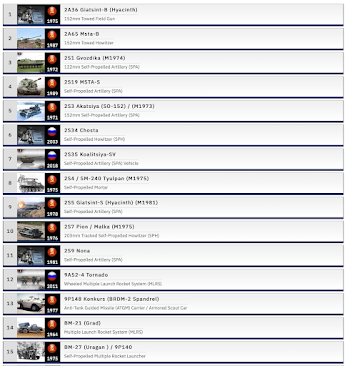
Here is a graphic showing Russia's army vehicles and artillery:
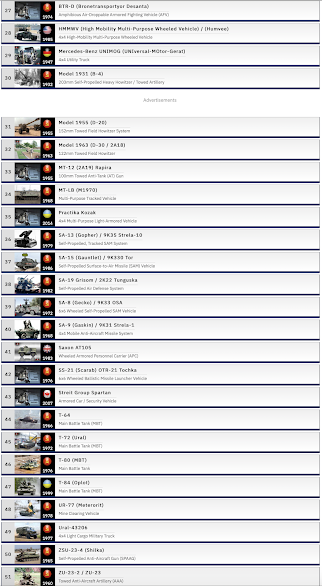
Here is a graphic showing Ukraine's army vehicles and artillery keeping in mind that much of Ukraine's land-based equipment is dated:
4.) Navalpower - total fleet strength - Russia 2nd place, Ukraine 53rd place
Ukraine essentially has a very limited ability to use its very small naval fleet to either defend itself or to use in offensive actions.
While Ukraine's military strength is far below that of Russia's, we have to keep in mind that the United States and United Kingdom (as well as other NATO nations) are supplying Ukraine's military with the materiel that it needs to fight against Russia.
The United States military has a new weapon that is currently being tested and, given its capabilities, one has to wonder how long it will be before the technology is used on the civilian population.
Here is the announcement from the United States Airforce:
The Global Information Dominance Experiment 3 also known as GIDE 3 took place at Peterson Air Force Base in Colorado on July 13, 2021. The first Global Information Dominance Experiment or GIDE 1 was held in December 2020 and the second exercise or GIDE 2 was held in March 2021. The most recent exercise involved North American Aerospace Defense Command and Norther Command Headquarters. This was the third series to tests which involved representatives from all eleven combatant commands within the United States Department of Defense. While few specific details have been released, the exercise involved both military sensors and commercially available data, using both sources for domain awareness.
Here is a quote from the news release about the GIDE events as a whole and GIDE 3 in specific with my bolds:
"These experiments use technology that is available today to enable decision makers to have relevant information sooner, thus creating decision space for senior leaders by providing proactive options. The series of GIDE events are technology risk-reduction experiments that complement a shift in focus from pure defeat mechanisms toward earlier deter and deny actions well left of conflict, consistent with the Defense Department’s prioritization of integrated deterrence.
Note the rather obscure use of the words "well left of conflict" as they are key to this technology.
Let's continue with the quote:
"The Global Information Dominance Experiment 3, or GIDE 3, was executed in three synchronized but distinct stages. Stage one focused on cost-effective data solutions to increase decision space through earlier indications and warnings. Stage two evaluated the ability to respond to contested logistics and demonstrated global collaboration to rapidly create deterrence options and dynamic contested logistics planning. The final stage, stage three, demonstrated the Joint Artificial Intelligence Center’s Matchmaker capability for machine-enabled crisis deterrence and conflict defense options. This was tied to live representative threats and real-world assets allowing the participating organizations opportunities to exercise global integration.
The GIDE 3 experiment showcased how the software tools designed for cross-combatant command collaboration, assessment, and decision-making can be used to enable more effective global logistics coordination, intelligence sharing and operations planning," said Gen. Glen VanHerck, NORAD and NORTHCOM commander. "By integrating more information from a global network of sensors and sources, using the power of AI and machine-learning techniques to identify the important trends within the data, and making both current and predictive information available to commanders, NORAD and USNORTHCOM are giving leaders around the globe more time to make decisions and choose the best options available, whether in competition, crisis or conflict.""
If you are interested in further information, here is a brief and interesting video outlining the GIDE exercises:
In brief, the GIDE 3 exercise, the team aggregated early indications and warnings through 120 days of geopolitical events. Real world alerts were used to indicate the actions of adversaries, in this case, a nuclear-armed nation which was not named during the post-exercise briefing . The experiment combined the use of global sensor networks, artificial intelligence and cloud computing resources in an attempt to "achieve informational dominance" and "decision-making superiority".
After the exercise, NORTHCOM Commander General Glen D. VanHerck conducted a press briefing were he outlined some very interesting aspects of GIDE 3, again with my bolds throughout:
"GIDE also makes a concerted effort to create global integration, shifting the department away from today's regionally-focused plans, strategies, the way we do force management and force design paradigms, and budgetary and acquisition processes. We're shifting our focus away from pure defeat mechanisms for homeland defense towards earlier, deter-and-deny actions well outside a conflict. GIDE spurs faster decisions and provides proactive options by making new technologies more accessible and more effective.
Right now, the threats we face and the pace of change in the geostrategic environment continues to advance at really alarming rates. We've entered a era of new and renewed strategic competition, and this time, we're facing two peer competitors, both nuclear-armed, that are competing against us on a daily basis. We must outpace our competitors by accelerating our own efforts to transform our culture, including factoring in homeland defense into every strategy, every plan, force management, force design decision, as well as aspects of acquisition and budget so that we can deter in competition, de-escalate in crisis and if required, defeat in conflict."
Here is a key quote:
"Specific to your question about artificial intelligence and what I call information dominance, we would take artificial intelligence and use machine learning to take a look and assess, for example, the average number of cars in a parking lot that may be there in a specific location to a competitor or a threat. And we monitor that over a period of time.
The machine learning and the artificial intelligence can detect changes in that and we can set parameters where it will trip an alert to give you the awareness to go take another sensor such as GEOINT on-satellite capability to take a closer look at what might be ongoing in a specific location.
What -- what we've seen is the ability to get way further what I call left, left of being reactive to actually being proactive. And I'm talking not minutes and hours, I'm talking days.
The ability to see days in advance creates decision space. Decision space for me as an operational commander to potentially posture forces to create deterrence options to provide that to the secretary or even the president. To use messaging, the information space to create deterrence options and messaging and if required to get further ahead and posture ourselves for defeat."
Let's repeat the key sentences:
"...what we've seen is the ability to get way further what I call left, left of being reactive to actually being proactive. And I'm talking not minutes and hours, I'm talking days.
The ability to see days in advance creates decision space."
Given the use of artificial intelligence, some may be concerned that machines will be making the decisions for the United States military. Not so, according to VanHerck:
"So, the first thing I would tell you that humans still make all the decisions in what I'm talking about. We don't have any machines making decisions. Certainly, machines can provide options.
So I see this not as something new that would create concern about utilizing this information to escalate. It actually is the opposite.
And -- and -- and keep in mind that it's not new information. It's information that today is just not analyzed and processed until later in the -- the -- the time cycle, if you will.
And all we're doing is taking it and sharing it and making it available sooner. So that our key decision-makers will have options vice being reactive where they may be forced to take some kind of escalation option. I hope that makes sense."
Let's close with these thoughts. General Glen VanHerck does his best to reassure us that we don't have a "Terminator-style" dystopian future where machines become self-aware and rid themselves of all of those nasty carbon-based lifeforms that are getting in the way of their dominance but he does little to reassure us that, at some point in the future, this technology won't end up being used by the private sector in combination with governments to predict our every move as is the case in a significant number of new (at the time) technologies like jet engines, ballistic missiles (space program) and nuclear technology among others. This technology also has a whiff of "precrime" about it, the basis of the movie Minority Report where the criminal justice system focussed on crimes not yet committed. But, then again, maybe my tinfoil hat is just a bit too tight today.
Here is a recent article from the United States Air Force Expeditionary Center website:
You will notice that the "object" behind Tech. Sgt. John Rodiguez is identified as a Ghost Robots Vision 60 prototype. Here is a further quote from the article:
"A team of 10 Airmen from the 621st Contingency Response Group participated in an agile combat employment exercise Sept. 1-3 at Buckley Air Force Base, Colorado, and Nellis AFB, Nevada, with other active-duty and Air National Guard Airmen from across the United States.
Devil Raiders brought their unique multifunctional skill sets to the exercise that also tested the Advanced Battle Management System, which is a state-of-the-art system designed to provide combatant commanders the ability to control Department of Defense assets in real time.
According to an Air Force news story, the goal of ABMS is to enable the Air Force and Space Force to operate together as a joint team – connecting sensors, decision makers and weapons through a secure data network enabling rapid decision making and all-domain command and control.
The 621st Contingency Response Wing team provided security forces, command and control, aircraft maintenance, aerial port and communications Airmen for the ACE exercise.
During the exercise, the team flew from Buckley to Nellis via New York’s 109th Airlift Wing LC-130 Hercules aircraft.
“After we land, everything moves quick,” said Tech. Sgt. Greg Hochgesang, 621st Contingency Response Squadron aircraft maintenance craftsman.
Once the Devil Raiders landed on the first chalk, the security forces Airmen secured the airfield in a traditional and unconventional way.
“Our defenders employed the robot dogs,” said Master Sgt. Lee Boston, 321st CRS loadmaster and the CR team chief for the exercise. “These robot dogs are a new technology that we’re testing as part of the exercise. The dogs give us visuals of the area, all while keeping our defenders closer to the aircraft.”
After the airfield was secured, maintainers assessed their own aircraft for damage, then marshalled the next LC-130 into its spot." (my bold)
For this security exercise, the United States Air Force deployed Ghost Robotics Vision 60 robot dogs as part of their test exercise.
Here is a screen capture from the "About" page of the Philadelphia-based Ghost Robotics (Robots That Feel the World) website:
Here is a video showing the Ghost Robotics Vision 60 Version 4 robot in action, using "Blind-Mode":
Note how quickly it recovers from being kicked or pushed over.
Here is a video showing the Ghost Robotics Vision 60 being deployed for public safety purposes:
So, not only are robot dogs coming soon to a war near you, this quadruped robot could be used by police/security forces as part of their operations to control demonstrators and provide security for their officers by providing real-time situational data.
The canine robots are currently unarmed...at least for now.
Here is a screen capture from the United States Naval Institute News website from February 2020:
Here is another screen capture from the same website from late January 2019:
The Second Fleet, which is headquartered at the Naval Support Activity Hampton Roads in Virginia, was reactivated in 2018 as a response to the "surge" in Russia's submarine activities. After 65 years of service, the Second Fleet was deactivated on September 30, 2011 because the United States Navy needed the funding for acquisitions as shown here:
Here is a quote from the commander of the United States Second Fleet, Vice Admiral Andrew Lewis, at a recent gathering of the U.S. Naval Institute and the Center for Strategic and Studies:
"Our new reality is that when our sailors toss the lines over and set sail, they can expect to be operating in a contested space once they leave Norfolk. Our ships can no longer expect to operate in a safe haven on the East Coast or merely cross the Atlantic unhindered to operate in another location..."
"We have seen an ever-increasing number of Russian submarines deployed in the Atlantic, and these submarines are more capable than ever, deploying for longer periods of time, with more lethal weapons systems. Our sailors have the mindset that they are no longer uncontested and to expect to operate alongside our competitors each and every underway."
Back in 2018, Chief of Naval Operations Admiral John Richardson explained his concerns about the encroachment of Russian and Chinese naval operations in the Atlantic, the traditional operating ground of the American fleet:
Here's a brief quote:
“We're talking about more [Russian submarine activity] than we've seen in 25 years. Even five years ago, we wouldn't have seen anything like this [Chinese naval activity]…” At least some of this activity by Russian's fleet of submarines is being undertaken to test NATO's abilities to track Russia's fleet as it pushes through the GIUK Gap (Greenland, Iceland, United Kingdom) a strategic bottleneck as shown here:
Let's look at the other side of the story, the Russian perspective of naval power. Here is an article from NATO's website dated September 2019:
Here is another article from NATO's website dated June 2019:
BALTOPS is an annual joint, multinational maritime-focused exercise designed to demonstrate the resolve of NATO partner nations in defending the Baltic Sea region. Here is a description of BALTOPS 2019 from the United States Navy website:
Note that this past year's exercise included 50 surface ships, 2 submarines and 36 aircraft and 8600 military personnel.
In case you aren't aware of the geographical setting of the Baltic Sea, here is a map of the region for your illumination:
You will notice that a very tiny portion of Russia borders on the eastern margin of the Baltic Sea (the location of the city of St. Petersburg). When the BALTOPs exercises take place, technically, they are immediately adjacent to one of the maritime borders of Russia.
With all of this information, you have to ask yourself, is it any wonder that Russian submarines are cruising the Atlantic Ocean which has been the stomping grounds of the United States Navy since the end of the Second World War, a situation that is causing a great deal of consternation in Washington? Given the alarms being sounded, one would almost think that Russian submarines located just offshore of America's east coast are about to launch an attack directly on Washington.
A rather interesting new video began to circulate in China on August 1, 2018, the nation's Army Day. Here is the video "I am a Chinese Soldier" in all of its nationalistic glory:
There is no English version of this video, however, I think that you can generally get the idea from the scenes presented. Fortunately, the fine folks at National Interest have translated the narration for us:
"Who am I?
I am the one the mother cannot reach at the door.
I am the wife who is reluctant to hang up the phone.
I am a stranger who dares not approach in the eyes of my son.
I am the concern and pride of my loved ones.
Peace behind me, war in front of me.
Pick up the steel gun, we must let go of the children.
Put on the military uniform, we must give up comfort and ease.
Fighting the battlefield, the character of the man.
From the military to the country, there is no regret in this life.
I am a Chinese soldier.
I am a soldier of the people.
I am the guardian of a good life."
I would have to say that the line "Peace behind me, war in front of me" is the most sobering part of the narration; it clearly states that, from the Chinese perspective, war is inevitable. The video which clearly shows off the nation's high tech weaponry also outlines the sacrifices that members of the People's Liberation Army (PLA) will make as they serve their nation and their people.
According to Global Firepower, China is ranked number three out of 136 nations considered to be a military power, following the United States in first place and Russia in second place. Here are a few key statistics about China's military and its ultimate manpower potential, a key part of any war:
Obviously, in a long war with high rates of attrition, the nation with the most human resources to draw from is more likely to win if all else is equal (or more-or-less equal). Given America's history of a shrinking military when measured in terms of manpower, this could prove to be yet another problem if the United States decides to declare war against one (or more, God help us) of its current headline enemies as shown here:
Here is an interesting quote from John Spencer, a former infantry company commander in Iraq, about the servicemen that he was forced to lead: "In 2008, when I was an infantry company commander in charge of over 140 soldiers in Baghdad, I saw firsthand how the declining number of volunteers is hurting the military. Thirty-six of my men were forced to deploy even though their terms of service were up, a controversial military policy known as “stop loss” or the “back door draft.” To meet the bare minimum number of soldiers, my unit took men who were medically unfit to fight. I had soldiers that could not leave our compound because they were medically prohibited from wearing their body armor or classified as mentally unfit. I had soldiers taking anti-depression, sleeping, anxiety and other drugs. I had a mentally unstable private viciously attack his sergeant, causing lifelong damage, and multiple other problem soldiers that detracted from the combat performance of my unit. This was symptomatic throughout the Army." He also notes that the current difficulties facing the United States in its attempts to assemble a full force dates back to 1973 when the draft was eliminated.
Under the current reality, it will be interesting to see if the United States adopts a divide and conquer strategy with China and Russia, partnering up with one of its two current foes since, at the very least, it is clearly out-manned and is increasingly under threat technologically. Given that any war with either foe will most like be fought in foreign territory, the United States faces the ever present logistical problems of recruiting and transporting sufficient military personnel into the theatre of operations in a very short timeframe to push back any moves by opposing forces.
I have been an avid follower of the world's political and economic scene since the great gold rush of 1979 - 1980 when it seemed that the world's economic system was on the verge of collapse. I am most concerned about the mounting level of government debt and the lack of political will to solve the problem. Actions need to be taken sooner rather than later when demographic issues will make solutions far more difficult. As a geoscientist, I am also concerned about the world's energy future; as we reach peak cheap oil, we need to find viable long-term solutions to what will ultimately become a supply-demand imbalance.






 Posts


